
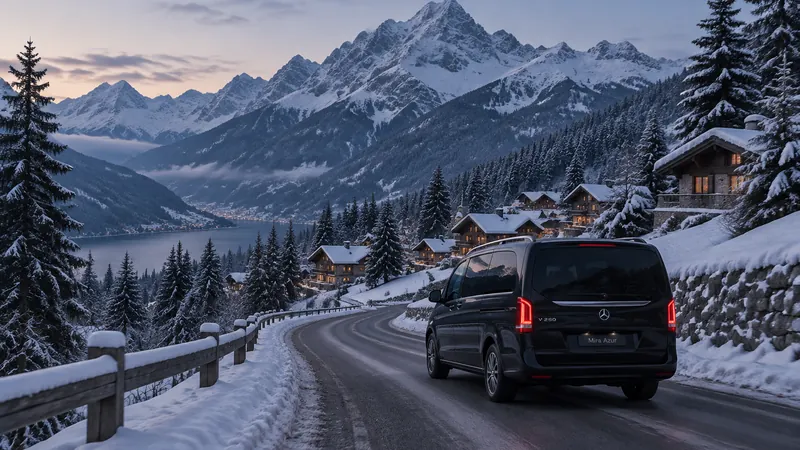
Ski Resort Transfers from Nice Airport
Fixed-price private transfers from Nice Côte d’Azur Airport to the ski resorts of the Alpes-Maritimes, Savoie and Switzerland — own fleet, own drivers, door to door.
Private transfers from Nice Airport to the Alps
Mira Azur runs private, fixed-price ski resort transfers from Nice Airport to every major Alpine destination within reach of the Côte d’Azur: the three ski areas of our own département, the Alpes-Maritimes (Isola 2000, Auron, Valberg), the Savoie giants of the Tarentaise and the Three Valleys, and the classic Swiss resorts across the border. One vehicle, one chauffeur, one price agreed before you travel — no meter, no per-kilometre surprise at the end.
Every fare on this page is all-inclusive: motorway tolls, airport pickup with meet and greet, fuel and winter equipment are built into the quoted price, and waiting time is included free of charge so a slow baggage carousel does not cost you anything extra. There is no night or seasonal surcharge added on top of these fixed routes.
For resorts not listed below — Les Menuires, Chamonix and similar — we still work on a fixed-price basis: send the details on [WhatsApp](https://wa.me/33689527286) and we return a custom quote within fifteen minutes.
Our own fleet and our own drivers for the whole journey
Mira Azur owns its vehicles and employs its own chauffeurs for the entire route, from the Nice Airport terminal to your chalet or hotel door. Nothing is subcontracted or resold to a local broker partway up the mountain: the driver who meets you at arrivals is the same driver who delivers you at the resort.
That matters on a long Alpine run. A single operator responsible for the whole trip can track your flight, plan around a closed pass or a Saturday changeover, and adjust the pickup time without a chain of phone calls between a booking agent and a subcontractor you never spoke to. If your plans change, cancellation is free up to 2 hours before pickup.
Ski resorts we serve from Nice Airport: distance, time and price
All times below are realistic winter estimates, including a comfort stop on the longer Savoie and Swiss routes; they lengthen somewhat in heavy snowfall. Prices shown are the Comfort-class starting fare — Business, Van, Business Van and First Class are all selectable on the booking form, with ski equipment carried free of charge in the vans and on request in the sedans.
| Resort | Distance | Journey time | Price from |
|---|---|---|---|
| Isola 2000 | ~95 km | 1h45 – 2h | from €220 |
| Auron | ~100 km | 1h50 – 2h | from €220 |
| Valberg | ~85 km | 1h30 – 1h45 | from €220 |
| Courchevel | ~515 km | 5h30 – 6h | from €900 |
| Méribel | ~500 km | 5h30 – 6h | from €970 |
| Val Thorens | ~510 km | 6h + | from €940 |
| Val d'Isère | ~520 km | 6h | from €960 |
| Tignes | ~515 km | 6h | from €950 |
| Zermatt | ~500 km | 5h30 – 6h | from €870 |
| St. Moritz | ~540 km | 6h – 6h30 | from €920 |
Alpes-Maritimes resorts: Isola 2000, Auron and Valberg
Isola 2000 is the closest high-altitude resort to the coast: about 95 km and 1h45 to 2h from Nice Airport. A same-day return is comfortable. Distances, vehicle classes, the price table and the FAQ are on the dedicated page: Nice Airport to Isola 2000 transfer.
Auron, in the Tinée valley, is around 100 km and 1h50 to 2h from Nice Airport, close enough for a same-day return. Route facts, vehicle classes and prices for every class are on the dedicated page: Nice Airport to Auron transfer.
Valberg is the nearest of the three, roughly 85 km and 1h30 to 1h45 from Nice Airport, and the easiest single day on snow from the coast. Full details, prices and FAQ: Nice Airport to Valberg transfer.
Nice Airport to Méribel
Méribel sits at the centre of the Three Valleys, about 500 km and 5h30 to 6h from Nice Airport. The route runs the A8, A51 and A43 motorways to Albertville, then climbs the Tarentaise valley on the RN90 through Moûtiers before the final ascent of roughly 1 000 m in continuous hairpins to the resort.
We drop off at the chalet or hotel door throughout the resort, including the higher hamlets of Méribel-Mottaret, wherever road access and the season allow.
Nice Airport to Val Thorens
Val Thorens, the highest resort in Europe at 2 300 m, is around 510 km and six hours or more from Nice Airport — the figure rarely drops below six in winter. The approach follows the same corridor as Méribel to Moûtiers, then the Belleville valley through Les Menuires before a final, exposed climb with very little tree cover.
The resort centre is car-free; we take you to the closest authorised set-down point for your residence and help with equipment from there.
Nice Airport to Val d'Isère
Val d'Isère is the longest of the Tarentaise transfers, about 520 km and a solid six hours, reached via Albertville and Bourg-Saint-Maurice before the road narrows into the Isère gorge for the final climb. It anchors the Espace Killy alongside Tignes.
Drop-off covers the central axis of the resort, La Daille and the Le Fornet side at altitude; a late-evening flight is routine for our drivers on this route.
Nice Airport to Tignes
Tignes shares the Espace Killy lift system with Val d'Isère but is reached by a separate final road, with a similar overall time of around 515 km and six hours. Past Bourg-Saint-Maurice the route climbs the Chevril valley alongside its dam and reservoir, a long, exposed shelf where wind rather than snow depth is usually the deciding factor.
We serve every level of the resort, from Tignes-les-Boisses down to Val Claret, with door drop-off wherever the resort’s pedestrian core allows.
Switzerland: Zermatt and St. Moritz
Beyond the French Alps, Mira Azur also runs fixed-price transfers into Switzerland. A Nice to Zermatt private transfer covers around 500 km and 5h30 to 6h to Täsch, the car-free resort’s gateway station, from where a shuttle train of about twelve minutes completes the journey into Zermatt itself.
A Nice to St. Moritz private transfer is the longest route we offer, around 540 km and 6h to 6h30, crossing into the Engadine on roads our chauffeurs know well in winter conditions.
Choosing your vehicle class
Every resort above can be booked in five vehicle classes, with the same fixed-price, all-inclusive principle applying across the range. Ski and snowboard equipment travels free of charge in the vans; in the sedan classes it is carried on request, so let us know the size of your kit when you book.
- Comfort — Tesla Model 3, Hyundai Niro or similar, up to 3 passengers
- Business — Mercedes E-Class, up to 3 passengers
- Van — Renault Trafic / Mercedes Vito, up to 8 passengers, skis and snowboards carried free
- Business Van — Mercedes V-Class VIP, up to 7 passengers, skis and snowboards carried free
- First Class — Mercedes S-Class, up to 3 passengers, ski equipment on request
Winter equipment and driver competence
Vehicles assigned to Alpine routes carry winter tyres and snow chains as required under the French mountain-equipment regulation in force each year from 1 November to 31 March, and our chauffeurs are experienced on Alpine passes rather than occasional visitors to them. Road conditions and snow bulletins are checked before departure so the route and timing reflect the day you actually travel, not a summer-time estimate.
Child seats — infant, toddler and booster — are provided free of charge on request; tell us the ages and weights when you book.
Day trips to the slopes from the coast
Isola 2000, Auron and Valberg are all close enough to the coast for a comfortable same-day return: leave Nice, Cannes or Monaco early, ski the full day, and be back for the evening. The Savoie and Swiss resorts, each 500 km or more one way, are a one-way transfer rather than a realistic day trip.
Clients arriving by private aviation can combine a coastal stay with a mountain day using our private jet transfer service for the Nice or Cannes–Mandelieu leg and a ski-resort transfer for the rest of the day.
Saturday changeover traffic in the Tarentaise
Saturdays in the Savoie season are changeover day across the Tarentaise valley, with departing and arriving guests converging on the same stretches of the RN90 at the same hours. We build extra margin into Saturday transfers on this basis, and it is also the day most likely to push a Courchevel, Méribel or Val Thorens run towards the upper end of its time range.
What is included in every fixed price
Every fare quoted on this page is fixed and all-inclusive, so the price you are shown is the price you pay regardless of traffic or a short delay. Full details of the fleet are on our fleet page and every route can be priced and booked on the pricing page.
- Fixed, all-inclusive price — motorway tolls, fuel and winter equipment built in
- Airport pickup with meet and greet, and free waiting time
- Flight tracking, so a delay does not cost you the transfer
- Free cancellation up to 2 hours before pickup
- Child seats (infant, toddler, booster) free on request
- No seasonal or night surcharge on these fixed routes
Frequently asked questions
Related transfers
Our guarantees
Every journey with Mira Azur comes with the same promises — clear pricing, careful planning and a chauffeur who looks after the details.
Fixed, transparent price
The price you see is the price you pay. No hidden fees, no surge pricing, no surprises at the end of the ride.
Flight monitoring & free waiting
We track your flight by number and adjust your pickup automatically. Generous complimentary waiting time is always included.
Professional chauffeurs
Experienced, English-speaking drivers in a spotless Mercedes fleet, fully licensed and insured for your peace of mind.
Flexible cancellation
Plans change. Cancel free of charge up to 2 hours before pickup — your card is only held as a secure guarantee.
Ready for the Slopes?
Book your private ski transfer from Nice today. Professional service, winter-equipped vehicles, and door-to-door convenience.
Explore More Destinations
Discover our private transfer services to other premium destinations on the French Riviera
Popular Transfers from Nice
Mira Azur provides premium private chauffeur transfers from Nice to the most popular destinations on the French Riviera and beyond.
We had a wonderful experience with Mira Azur when travelling between Nice and St. Tropez! First - their customer service was great with communication and professional. Everything was done via WhatsApp which was very convenient. Second - our drivers were excellent with their service, warmth and driving. The cars were clean, stocked with water bottles and candies. We will definitely be using their services again when we come to the South of France in the future!
Gabriella Tam
On time and very professional from start to finish. Quick responses to questions and easy to book online. The cars were clean and comfortable and the drivers drive safely. I initially only booked for my arrival from the airport to my hotel, but I loved it so much, when it was time to leave I booked them again to take me back to the airport 3 weeks later.
Kali R
I had an excellent experience with MirAzur transport company from Nice Airport to Monaco. The car was very clean, comfortable, and perfectly maintained. The driver was professional, punctual, and very pleasant during the whole trip. He was polite, helpful, and made the journey smooth and relaxing. I highly recommend MirAzur for anyone looking for a reliable and high-quality transfer service between Nice Airport and Monaco. Thank you very much
Georges B
Perfect transport from Villefranche sur/Mer to Nice. I would recommend this gentleman and his comfortable MBZ Van to anyone, single or a group, with baggage, or touring .. Mannered and safe driver. A pleasant experience all the way around.
Paul Morse Brown
Nice to Milan, via Monaco. Roman was fantastic! Arrived on time, gave us options for the stop over. Explained the scenary as we drove past. Supplied water and candy for the kids. Presented well and impeccable car. Highly recommend
Nathan Frohloff